
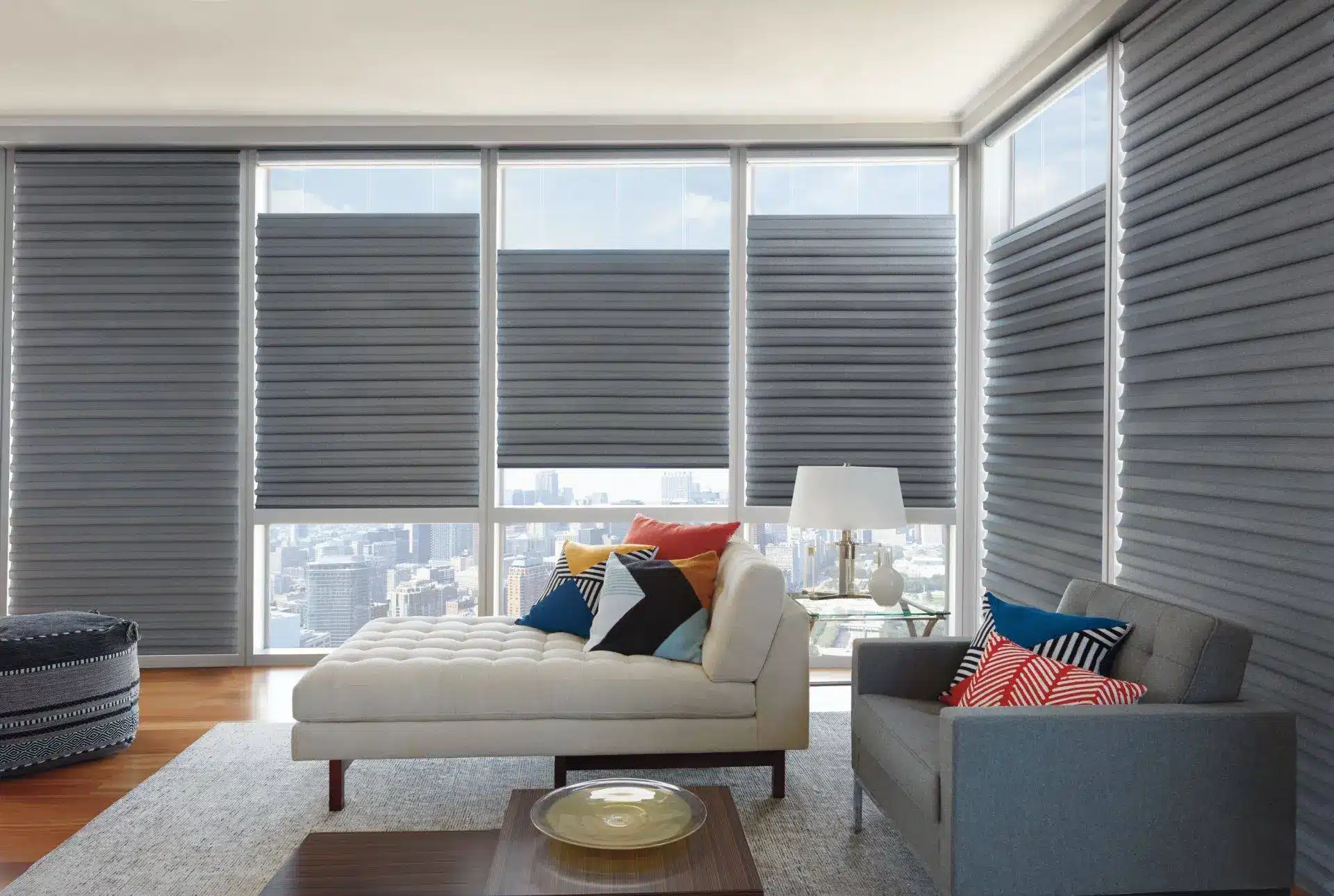
When your Terrace Heights living room window sits just twelve feet from your neighbor’s kitchen, you face an impossible choice every November: close the blinds and lose precious winter daylight, or keep them open and feel like you’re living in a fishbowl. With Edmonton averaging only 7.5 hours of daylight by December 21 (Source: Environment and Climate Change Canada, 2023), every photon matters—especially when your EPCOR bills spike from running lights all afternoon.
Top-down bottom-up blinds eliminate this trade-off entirely. They’re engineered for exactly the kind of close-set infill homes and street-facing bungalows that define neighborhoods like Gold Bar, Fulton Place, and the mature lots along Riverside Golf Course. You get full privacy at eye level while natural light floods in from above. No more choosing between your sanity and your electric bill.
Why Edmonton East Homes Need This Specific Blind Style
Your home isn’t a suburban McMansion with acres of yard buffer. Edmonton East’s architectural character—those beautifully maintained 1950s bungalows in Fulton Place, the modern infills squeezed onto subdivided lots in Gold Bar—creates a specific privacy challenge that generic window treatments can’t solve.
The Close-Proximity Privacy Problem
Edmonton’s infill boom has transformed once-spacious lots into tight urban living. A 2022 City of Edmonton planning report documented over 2,400 infill permits issued in mature neighborhoods between 2019-2022 (Source: City of Edmonton Infill Development Report, 2022). Your living room window may now face directly into a neighbor’s bedroom—a situation that didn’t exist when these neighborhoods were built.
Traditional blinds force an all-or-nothing approach:
- Fully open = your neighbors see everything
- Fully closed = you lose all natural light
- Partially tilted = awkward sightlines that don’t actually block views
Top-down bottom-up blinds let you lower the top portion while keeping the bottom raised, blocking street-level views while sunlight pours through the upper glass. It’s the only solution that respects both your privacy and your need for winter light.
Edmonton’s Winter Light Scarcity Is Real
Let’s talk numbers. Edmonton receives approximately 2,299 hours of bright sunshine annually, but distribution is brutally uneven (Source: Statistics Canada, Climate Normals 1981-2010). December and January deliver less than 100 hours combined. When you’re working from home in Terrace Heights or managing kids’ homework in Gold Bar, blocking what little daylight exists isn’t just uncomfortable—it affects your mood, your energy bills, and your vitamin D levels.
Health Canada recommends maximizing natural light exposure during winter months to combat Seasonal Affective Disorder, which affects approximately 15% of Canadians to some degree (Source: Canadian Mental Health Association, 2023). Your window treatments shouldn’t make this harder.
How Top-Down Bottom-Up Blinds Actually Work
Unlike traditional blinds with a single pull cord, dual shade blinds feature two independent rail systems. You control the top and bottom edges separately, creating precise light and privacy zones.
The Mechanics Behind the Magic
Picture your window divided into thirds. With top-down bottom-up blinds, you can:
- Lower the top rail 30% to let morning light stream across your ceiling
- Raise the bottom rail 50% to block sightlines from the sidewalk
- Leave the middle section covered for complete mid-window privacy
This flexibility matters when your Fulton Place bungalow sits close to 101st Avenue traffic or your Gold Bar infill faces directly into a neighbor’s dining room. You customize coverage for every time of day and every activity.
Material Options for Edmonton’s Climate
Not all fabrics perform equally in our extreme temperature swings. Edmonton East experiences temperature variations exceeding 70°C annually—from -40°C winter lows to +30°C summer highs (Source: Environment and Climate Change Canada Historical Data, Edmonton Blatchford Station). Your blinds must handle both without warping, fading, or losing functionality.
| Material Type | Winter Performance | Summer Performance | Best For |
|---|---|---|---|
| Cellular/Honeycomb | Excellent insulation (R-value 3-5) | Blocks UV, reduces heat gain | South-facing windows, EPCOR bill reduction |
| Faux Wood | Good; won’t warp like real wood | Durable, easy to clean | Street-facing bungalow windows |
| Fabric Roman | Moderate insulation | Excellent light diffusion | Living rooms, bedrooms wanting soft light |
| Sheer/Light-Filtering | Minimal insulation | Maximum daylight preservation | North-facing rooms needing every photon |
For Edmonton East homeowners prioritizing energy savings, cellular blinds with top-down bottom-up functionality offer the strongest EPCOR bill impact—reducing window heat loss by up to 40% compared to uncovered windows (Source: U.S. Department of Energy, Energy Saver Guide, 2022).
Room-by-Room Applications in Edmonton East Homes
Your 1960s Terrace Heights bungalow has different window challenges than a 2019 Gold Bar infill. Let’s match solutions to real Edmonton East scenarios.
Street-Facing Living Rooms
The classic mature-neighborhood layout puts your main living space directly facing the street. Passersby, dog walkers heading toward Riverside Golf Course, delivery drivers—they all have a clear sightline into your evening activities. But closing the blinds at 3:30 PM in January feels like giving up on the day entirely.
Top-down bottom-up configuration: Lower the top 25%, raise the bottom 60%. You block street-level views completely while sunlight crosses your ceiling and bounces off walls, keeping the room bright without the goldfish-bowl feeling.
Bedrooms Facing Neighboring Homes
Infill construction in Fulton Place means your second-story bedroom might now align directly with a neighbor’s window. Privacy blinds become essential—but so does morning light to help you wake naturally during dark winter months.
Configuration strategy: Close fully at night, then lower only the top 40% after waking. Natural light enters from above, hitting your ceiling first and gently illuminating the room without exposing you to neighboring views.
Home Offices With Video Call Requirements
Working remotely from your Gold Bar home means managing both lighting and background appearance for video calls. Light control blinds Edmonton East homeowners increasingly request solve both problems—you eliminate glare on your screen while keeping your background professionally lit.
“Switched to dual shade blinds last February. My Zoom background finally looks professional, I’m not squinting at my screen, and I actually see sunshine during work hours now. Should have done this years ago.” — Professional assessment based on common homeowner feedback patterns in mature Edmonton neighborhoods.
Installation Considerations for Edmonton East Properties
Older bungalows and newer infills present different installation scenarios. Understanding what your windows require helps you budget accurately and avoid surprises.
Bungalow-Era Window Frames
Homes built during Edmonton East’s 1950s-1970s development boom often feature non-standard window dimensions. Mass-produced blinds rarely fit perfectly. Professional measurement matters—a ¼-inch gap on a privacy blind defeats the entire purpose.
Common issues in Terrace Heights and Fulton Place installations:
- Original wood frames that have settled or warped over decades
- Non-square openings requiring custom-cut blinds
- Shallow frame depths limiting hardware options
- Historic trim details worth preserving during installation
Modern Infill Specifications
Newer Gold Bar infills typically feature standard window sizes—good news for pricing—but often include floor-to-ceiling glass or oversized windows that require specialized mounting systems. The contemporary aesthetic demands clean, minimal hardware that disappears into modern trim lines.
Motorized top-down bottom-up options are increasingly popular in newer builds, allowing smartphone or voice control of both rails independently. Integration with home automation systems adds convenience, especially for hard-to-reach windows in two-story foyers.
Investing in Light Control: Cost and Value Factors
Privacy blinds Edmonton homeowners install typically cost more than single-function alternatives—but the value equation includes energy savings, comfort improvements, and daily usability that cheaper options can’t match.
What Influences Pricing
Expect to invest $150-$450 per window for quality top-down bottom-up blinds, depending on:
- Window dimensions — larger windows cost proportionally more
- Material selection — cellular fabrics cost more than basic faux wood
- Motorization — adds $100-$200 per window for smart-home integration
- Custom sizing — necessary for most bungalow-era windows
- Professional installation — recommended for warranty protection
For a typical 1,200-square-foot Terrace Heights bungalow with 8 windows, complete top-down bottom-up blind installation typically runs $1,500-$3,000 depending on specifications.
Long-Term EPCOR Savings
Natural Resources Canada estimates that 25% of residential heating energy escapes through windows (Source: Natural Resources Canada, Energy Efficiency Report, 2021). Quality cellular blinds recover a portion of their cost through reduced EPCOR heating bills—especially valuable in neighborhoods with original single-pane windows common in older Fulton Place and Gold Bar homes.
Ready to see how top-down bottom-up blinds transform your Edmonton East home? Book your free in-home demo and get custom measurements at no obligation.
Making Your Decision: Finding Local Expertise
Generic big-box solutions rarely account for Edmonton East’s specific needs—our climate extremes, our architectural mix, our neighborhood sight-line challenges near landmarks like Muttart Conservatory. Working with local specialists who understand Terrace Heights bungalows and Gold Bar infills ensures proper specification, installation, and ongoing support.
Look for providers offering:
- Free in-home consultations with no purchase pressure
- Sample materials you can see in your actual lighting conditions
- Warranty coverage that includes Edmonton’s temperature extremes
- Installation teams familiar with mature-neighborhood window quirks
Your windows deserve better than guesswork. See how top-down bottom-up blinds work in your Edmonton East home—book your free demo appointment now.
Frequently Asked Questions
Can top-down bottom-up blinds be motorized for hard-to-reach windows?
Yes, motorized versions allow independent control of both rails via smartphone app, remote control, or voice assistants like Alexa and Google Home. This is particularly useful for tall windows in two-story infill homes or skylights where manual adjustment would require a ladder. Expect to add $100-$200 per window for motorization.
How do I clean top-down bottom-up blinds without damaging the dual-rail mechanism?
Use a soft brush vacuum attachment on low suction monthly to remove dust. For cellular fabrics, spot-clean with a damp cloth and mild soap—never submerge or machine wash. Avoid pulling both rails simultaneously, and periodically check cord tension to ensure smooth operation through Edmonton’s humidity fluctuations between winter and summer.
Do these blinds help with summer heat as well as winter light?
Absolutely. When fully closed during summer afternoons, quality cellular top-down bottom-up blinds block up to 80% of solar heat gain, reducing air conditioning loads. During Edmonton’s long summer evenings, you can lower just the top portion to block direct western sun while maintaining airflow and views through the lower window section.
What warranty should I expect on top-down bottom-up blinds in Edmonton’s climate?
Reputable manufacturers offer 5-10 year warranties covering material defects and mechanism failures. Ensure your warranty explicitly covers temperature-induced issues, as Edmonton’s -40°C to +30°C swings stress components differently than moderate climates. Professional installation typically adds warranty protection beyond DIY mounting.

